_(1).svg)
Gua Sha is now one of the most popular tools in the fields of beauty and traditional Chinese medicine. Many people know it as an aesthetic aid made of rose quartz or jade, which helps firm and brighten the skin. However, the original meaning of Gua Sha is much deeper. This technique has been used for thousands of years and brings effects ranging from supporting the lymphatic system to releasing muscle blockages.
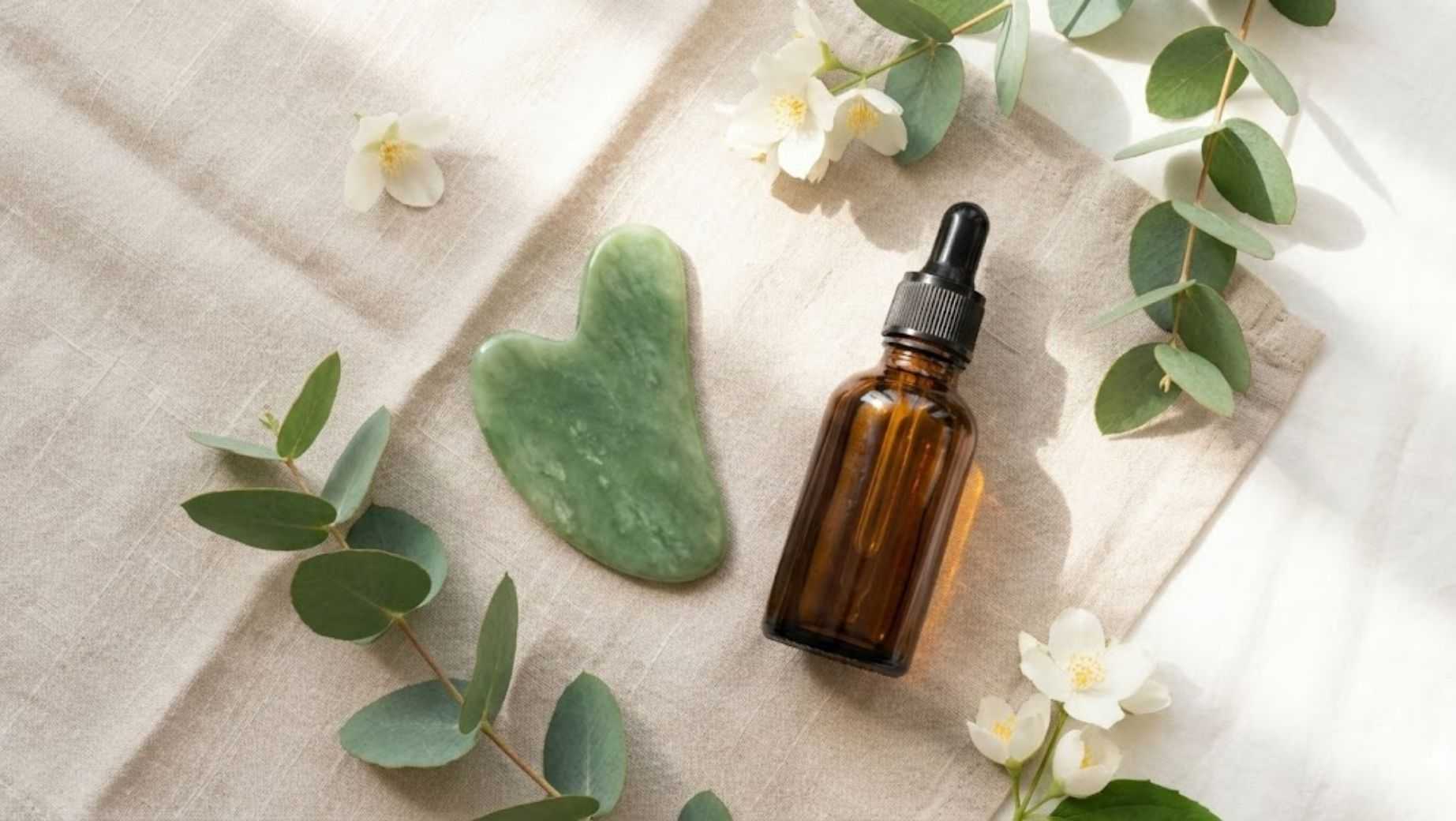
What is Gua Sha?
Gua Sha is a traditional Chinese method that combines a massage technique with the use of a special stone. The name consists of two words:
- Gua = “to scrape” or “to rub”
- Sha = “redness” or “congested energy”
In practice, this means that the stone is applied to the skin and gentle, repeated strokes create pressure that stimulates blood microcirculation, lymph flow, and the release of tension in the tissues.
Unlike an ordinary massage tool, Gua Sha has a special shape. It features specific rounded edges, notches, and curves to adapt to particular areas of the face and body.
5 Main Benefits: Why Use Gua Sha?
Gua Sha has a wide range of uses, both in cosmetics and in full-body care. Here are its most important effects:
1. Support of the lymphatic system and drainage
One of the most well-known effects of Gua Sha is lymphatic drainage. Gentle strokes toward the lymph nodes improve lymph flow, which means:
- swelling subsides (in the morning, after exertion, during prolonged sitting),
- the skin looks fresh and rested,
- the feeling of “heaviness” in the face is reduced.
Gua Sha is ideal, for example, for under-eye puffiness or fluid buildup in the lower part of the face.
2. Improved blood circulation and microcirculation
Massage with Gua Sha significantly supports blood circulation. Better circulation:
- improves skin oxygenation,
- supports collagen production,
- brings faster cell regeneration,
- helps restore the skin’s natural radiance.
This is why Gua Sha is often used as part of an anti-aging routine. After the massage, the skin is slightly pink, looks more vibrant and healthier, and gains that desired natural glow, the so-called glow effect.
3. Release of tension and muscle blockages
Many people suffer from tension in the jaw, neck, or shoulders. Gua Sha helps loosen stiff muscles and fascia. With regular use, you may experience:
- relief from jaw joint pain (e.g., from teeth grinding – bruxism),
- relief of tension that causes headaches,
- better posture and a more relaxed neck.
For the body, larger and more robust Gua Sha stones are used.
4. Improved skin texture and anti-aging effect
Regular use of Gua Sha can improve the overall appearance of the skin:
- smoothing of fine lines,
- better skin firmness (natural lifting),
- even skin tone,
- reduction of “incipient” wrinkles caused by muscle tension.
It is not an invasive technique, but the results are natural and gradual.
5. Reduction of inflammation and detoxification
In traditional Chinese medicine, Gua Sha is also used to support the body in cases of:
- back pain,
- chronic tension,
- a feeling of energy stagnation,
- muscle fatigue,
- coldness of the limbs.
The massage supports the detoxification function of the skin and the overall balance of the body.
Gua Sha for the face vs. the body: What’s the difference?
You may have seen photos where red marks or small bruises remain on the skin after Gua Sha massage. It is important to distinguish between traditional body therapy and modern cosmetic massage.
-
Gua Sha for the body (therapeutic): In traditional Chinese medicine, stronger pressure is used to release deep muscle pain and blockages. The goal is to “draw out” heat and toxins to the surface, which manifests as redness (the so-called “sha”).
-
Gua Sha for the face (cosmetic): Here the rule applies: no bruises! The procedure is much gentler and slower. The goal is not to create red marks, but to gently stimulate lymph flow and increase blood circulation in the subcutaneous tissue. If you look like you’ve been in a fight after a facial massage, you are applying too much pressure. Proper facial Gua Sha is relaxing and painless.
Which stone to choose? Jade vs. Rose Quartz
Although technique is more important than material, in crystal therapy each stone has its own energy:
-
Jade (green): The traditional stone for Gua Sha. It is naturally cooling (great for morning puffiness) and in TCM is considered a stone of balance and health.
-
Rose quartz (pink): The stone of love and self-love. It is harder than jade and retains temperature longer (if heated or cooled). Ideal for evening calming rituals.
-
Steel (stainless): A modern option. It is antibacterial, unbreakable, and extremely cooling.
How to use Gua Sha correctly?
-
Prepare the skin: Hydration is key. Apply a sufficient amount of facial oil to cleansed skin. The stone must glide over the skin, not drag it!
-
Angle is key: Always stroke upward or toward the lymph nodes. Do not hold the stone perpendicular (90°), but almost flat (at an angle of approx. 15–45° to the skin). Correct direction is crucial. Use long, slow strokes.
-
Stroke direction: Always massage from the center of the face outward (toward the ears) and on the neck downward (for lymph drainage).
-
Pressure: Be gentle. The goal is not to scrape the skin, but to stimulate the subcutaneous tissue. Redness is fine, bruises are not.
-
Repetition: Repeat each stroke 3 to 5 times.
Consistency is key, and you can ideally use Gua Sha 3–5 times a week, and on the body as needed.
Who is Gua Sha suitable for? (And when to avoid it)
Gua Sha is an incredibly versatile method that will delight both beauty lovers and those seeking pain relief. In general, it is an ideal choice for:
-
those who want to rejuvenate their skin naturally: If you are looking for a non-invasive alternative to botox and want to improve skin tone and appearance.
-
people prone to swelling: A great helper for “deflating” morning under-eye bags and puffy cheeks.
-
people under stress: The massage works as a deep relaxation ritual that helps release mental tension after a demanding day.
-
athletes and sedentary occupations: Gua Sha is not just about the face, but also helps athletes with strained muscles or people who suffer from chronic neck, shoulder, and back pain from sitting at a computer.
When should you avoid the massage?
Although Gua Sha is safe, avoid it in cases of active acne (risk of spreading infection), inflammation, or sunburned skin. Do not perform the massage over fresh scars, open wounds, or skin infections. If you have undergone botox or filler injections, wait at least 3–4 weeks before using it.
Conclusion
So what is Gua Sha used for? It is much more than just a pretty accessory on a shelf. It is a tool that teaches you to slow down, devote time to yourself, and literally “iron out” stress from your face. With regular use, your skin will reward you with reduced puffiness, a brighter tone, and firmer contours.
Author: Terka