
Standing in front of three Thai inhalers and wondering which one actually belongs in your pocket? Hong Thai, Poy Sian and Hanuman all promise a cool, clear breath, yet they differ in format, strength and scent far more than most people expect. We compared them side by side so you can see which one fits your nose, your routine and your sensitivity. Read on and find out which Thai inhaler is truly right for you before you buy your next one.
What is the difference between Hong Thai, Poy Sian and Hanuman?
The biggest difference is format and intensity. Poy Sian is a slim stick with a soaked wick and a built in cooling oil, and it delivers the sharpest menthol hit of the three.
Hong Thai and Hanuman are jars filled with real dried herbs, so their scent is fuller and more complex. Hong Thai leans fresh and cooling, while Hanuman leans softer and spicier.
All three belong to the same Thai tradition known as ya dom, which literally means medicine you smell. In Thailand you will see them in pockets, handbags and car cup holders, and people reach for them as casually as Europeans reach for chewing gum.
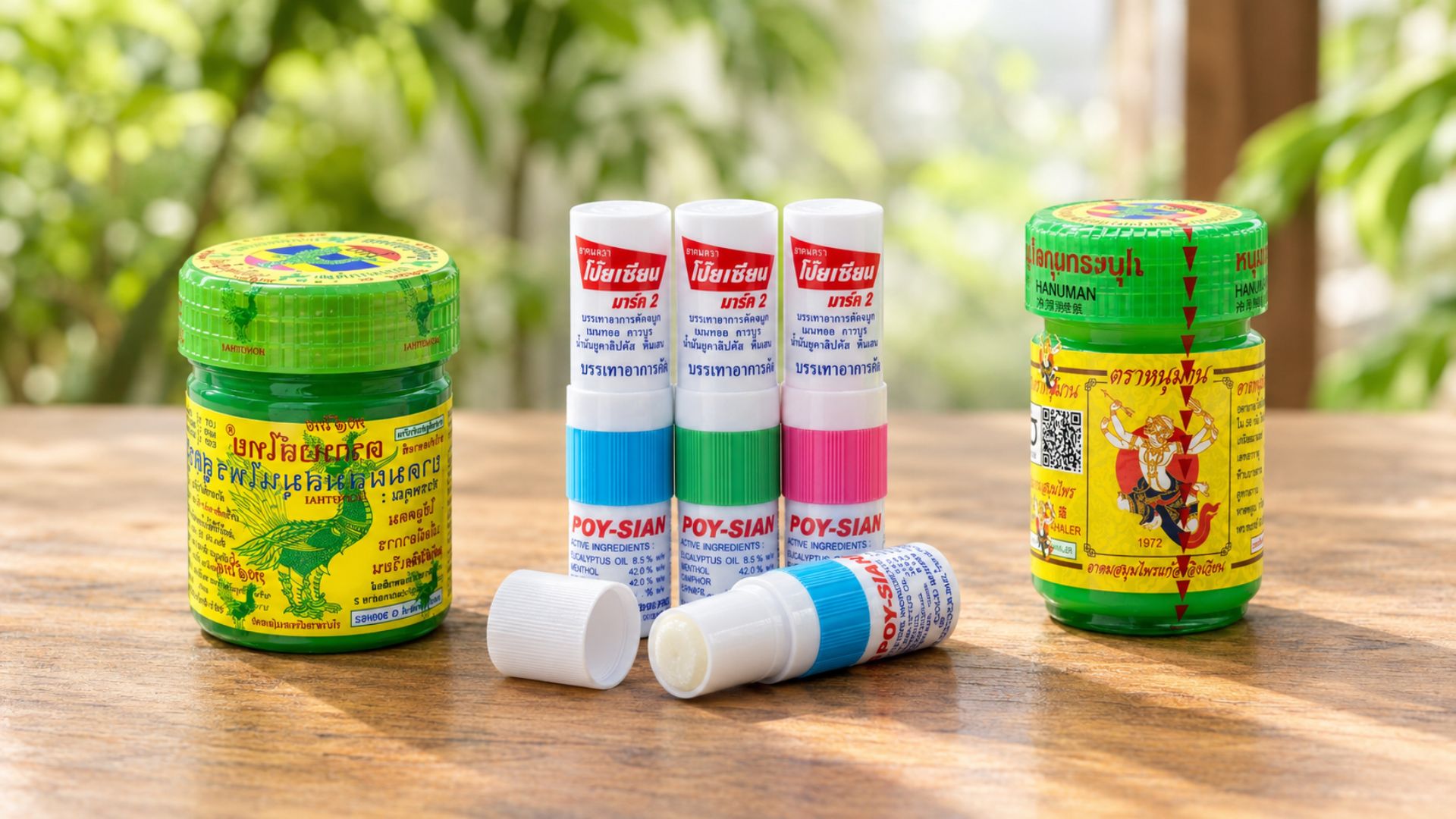
Stick inhalers vs. jar inhalers
Stick inhalers hold a cotton wick soaked in essence. The aroma is concentrated, quick and very direct, which is why stick inhalers feel stronger after just one breath.
Jar inhalers are filled with dried herbs and spices infused with essential oils. The scent unfolds more slowly and in layers, first a cool freshness, then the herbs and finally warmer notes.
Neither format is better in general. It simply depends on whether you want a fast, sharp kick or a rounder, more aromatic experience.
Where each brand comes from
Poy Sian is the veteran of the group and has been sold in Thailand since 1936. Its slim tubes sit by the till in almost every Thai convenience store.
Hong Thai is the brand that turned Thai inhalers into a global trend, and if you want the full story you can read about the effects and origin of Hong Thai. Its green jar became an icon thanks to social media and travellers bringing it home as a souvenir.
Hanuman is made by the Thai company Samunprai Hanuman Co., Ltd. and is named after the monkey hero of the Ramakien, a symbol of strength, speed and loyalty. In 2026 it went viral in China after a well known Chinese actress showed it in a video.
Which Thai inhaler is the strongest?
Poy Sian is the strongest of the three. Its Mark II version contains 42% menthol, 16.4% camphor, 8.5% eucalyptus oil and 6.1% borneol, which makes it noticeably more intense than both herbal jars and far stronger than ordinary menthol sticks from European chemists.
Hong Thai comes second. It is strong and very cooling, but the dried herbs soften the edge and give it a rounder finish.
Hanuman is the gentlest of the trio. Menthol is present, yet the herbs and spices take the lead, so the effect feels more aromatic than piercing.
Here is a quick side by side overview:
| Inhaler | Format | Key ingredients | Scent | Intensity | Best for |
|---|---|---|---|---|---|
| Hong Thai (green) | Jar with dried herbs in gauze | Menthol, camphor, borneol, eucalyptus oil and around 15 herbs | Cool, herbal, full | Strong | Everyday use, office, driving |
| Poy Sian Mark II | Slim two in one stick with oil reservoir | Menthol 42%, camphor 16.4%, eucalyptus oil 8.5%, borneol 6.1% | Clean, sharp menthol | Very strong | Blocked nose, travel, headaches |
| Hanuman | 20 g jar with dried herbs and spices | Thai herbs and spices with menthol, camphor and borneol | Herbal, spicy, layered | Medium | Sensitive noses, relaxation, first timers |
Keep in mind that strength is not the same as quality. A softer inhaler can be the better choice if you use it often, have a sensitive nose or simply enjoy the scent more than the shock.
Hong Thai: the herbal classic with a strong cooling kick
Hong Thai is the best all round choice for most people. It combines a refreshing menthol hit with the depth of around fifteen traditional Thai herbs wrapped in gauze and soaked in menthol, camphor, borneol and eucalyptus oil.
That balance is why the classic green Hong Thai herbal inhaler works equally well in the office, behind the wheel or on a crowded train. It wakes you up without feeling as aggressive as a pure menthol stick.
Which Hong Thai colour should you choose?
The green jar is the original and most versatile version. The Hong Thai Yellow offers a slightly milder but more complex herbal aroma, which many people prefer for calmer moments.
The Hong Thai Borneol Herb Water version is the most intense option in the family and is popular during heavy colds and sinus pressure. If you want to compare all three in detail, our guide on which type of Hong Thai is the best walks you through every variant.
Is Hong Thai still safe to use?
Yes, genuine Hong Thai is safe for most adults when used as directed. In late 2025 the brand recalled one specific batch of Formula 2, batch number 000332, after the Thai FDA found microbial contamination, and only that batch was affected.
The company removed it from the market and tightened its quality control. You can read everything about the formula and the recall in our article on Hong Thai herbal inhaler ingredients and safety.
Poy Sian: the strongest menthol stick with a cooling oil
Poy Sian is the right pick if you want maximum strength in the smallest package. The Poy Sian Mark II two in one herbal inhaler has two ends, one with an inhaler wick and the other with a reservoir of cooling oil for your skin.
This makes it a favourite for travel, blocked noses and tension headaches. One slim tube slips into any pocket, and the separate screw caps keep the scents from mixing or leaking.
What does Mark II mean?
Mark II is simply the two in one version of Poy Sian. Besides the classic inhaler stick, it hides a small bottle of oil in the other end.
The classic Poy Sian without oil is an inhaler only. If you like having options in one tube, Mark II is the more practical choice.
How should you use the oil end?
Let a single drop fall onto your temples, the back of your neck or a handkerchief. Many people also put a drop on their pillow or a scarf when travelling.
Never apply the oil inside the nose, near the eyes or on mucous membranes. Because of the high menthol content, Poy Sian is meant for adults only, and you should start with one gentle breath from a little further away.
If you enjoy the cooling oil but want something for a proper massage, a Thai herbal balm such as Wangprom green Thai herbal balm is a natural next step.
Hanuman: the softer and spicier herbal jar
Hanuman is the best choice for sensitive noses and anyone who finds menthol too harsh. The Hanuman herbal inhaler comes in a 20 g screw top jar filled with dried Thai herbs and spices infused with menthol, camphor and borneol.
Its scent is the most layered of the three. You get a fresh coolness first, then a herbal middle and finally soft, warm spice.
Why did Hanuman become so popular?
In Thailand, Hanuman has long been a familiar sight in pharmacies and convenience stores. Its big moment abroad came in May 2026, when Chinese actress Zhao Lusi posted a video with the jar on her table and fans quickly tracked down the brand.
Since then it has become one of the most searched Thai inhalers outside Asia. Many new users like it because it feels more like aromatherapy than a menthol blast.
Hanuman or Hong Thai?
Both are jar inhalers with real dried herbs, so they share the same traditional principle. The difference is in the balance.
Hong Thai leads with strong menthol, while Hanuman is more herbal and spicy. If Hong Thai feels too sharp for you, Hanuman is usually the perfect step down.
Which Thai inhaler is best for your situation?
The best Thai inhaler depends on what you need it for. Poy Sian wins for speed and strength, Hong Thai for everyday versatility and Hanuman for comfort and relaxation.
Here is a simple guide to help you decide:
- For a blocked nose and colds reach for Poy Sian or the white Hong Thai, and combine them with the other simple tips in our guide on how to get rid of a cold.
- For tension headaches try a drop of Poy Sian oil on your temples or a few slow breaths of green Hong Thai.
- For focus while studying or working green Hong Thai gives a clean refresh, and it pairs well with these supplements for better learning.
- For long drives and afternoon slumps keep Hong Thai or Poy Sian within reach, and keep an eye on when to drink your last coffee so you still sleep well at night.
- For relaxing in the evening Hanuman or Hong Thai Yellow feel calmer and softer, especially alongside these tips for better sleep.
- For travel and stuffy public transport the slim Poy Sian tube is the easiest to carry and the quickest to use.
- For first timers and sensitive noses start with Hanuman and move to stronger inhalers only if you want more intensity.
If you cannot decide, many fans keep two inhalers, a strong one for the day and a softer one for quiet evenings.
Are Thai inhalers safe to use every day?
Yes, Thai inhalers are generally safe for daily use by healthy adults, as long as you use them in moderation. Hold them 1 to 2 cm from your nostril, breathe in gently and never insert them into the nose.
Overuse can cause mild irritation, a burning feeling or headaches. It is also wise not to share your inhaler with others, which is exactly what Thai health authorities recommend.
Can Thai inhalers become addictive?
There is no evidence of chemical addiction, because menthol and camphor do not work like drugs. What can happen is a habit of frequent sniffing, simply because the cooling sensation is so pleasant.
If you notice you reach for it every few minutes, take a short break. Our article on how to know if you are addicted to anything explains the difference between a harmless habit and real dependence.
Who should avoid Thai inhalers?
Young children should not use them, because camphor and high doses of menthol are not suitable for small kids. People with asthma or known allergies to any ingredient, as well as pregnant women, should ask a doctor first.
If you notice any reaction such as swelling, rash or tight breathing, stop using the inhaler immediately.
How long does a Thai inhaler last
A herbal jar like Hong Thai or Hanuman usually stays potent for 3 to 6 months with daily use, provided you close it tightly after every sniff. Stick inhalers like Poy Sian fade faster if the cap is left loose or the tube sits in a hot car.
To keep the scent strong, screw the cap on tightly and store your inhaler away from direct sunlight. With Hong Thai you can also give the closed jar a firm shake to move the oils from the bottom back to the herbs.
When the aroma becomes weak, it is time for a new one. A tired inhaler will not harm you, but it will not give you the fresh kick you expect either.
Conclusion
So which Thai inhaler is right for you? Choose Poy Sian if you want the strongest menthol hit and a cooling oil for your temples in one slim stick. Go for Hong Thai if you want the classic all round herbal inhaler that balances freshness, depth and everyday comfort. Pick Hanuman if you prefer a softer, spicier and more layered scent that is kinder to sensitive noses.
Whichever you choose, buy a genuine sealed product, sniff gently from a short distance and keep the cap tightly closed so it stays fresh for months.